Meta, the parent company of Facebook and other popular platforms, led by CEO Mark Zuckerberg, has announced a new feature that could change how people participate in virtual meetings. This new feature involves launching a standalone Zoom application designed specifically for Meta Quest virtual reality headsets. In simple terms, it allows users to attend Zoom meetings not just as themselves but as customizable virtual avatars within a 3D environment. This move aims to improve the experience for people who want to feel more connected and engaged during virtual meetings, especially in VR. This blog discusses about Standalone Zoom App.
New Zoom App
The new Zoom app is currently free to download for owners of Meta Quest VR headsets, including models like Meta Quest 3, Meta Quest 3S, Meta Quest Pro, and Meta Quest 2. It’s compatible with any Zoom license, whether users have a basic free account or a paid subscription with additional features. This flexibility makes it easy for anyone with a compatible headset to take part in meetings using this new virtual avatar technology.
Meta also explained in a blog post that this new VR Zoom app extends the capabilities of the existing Zoom Workplace app that many users already use on their smartphones and computers. The goal was to create an experience that feels familiar but is optimized for VR headsets, offering a more immersive way to communicate. The app enables users to join video calls and meetings with virtual avatars, which can be customized to resemble their real selves or to express their personality. The app offers two main modes: Immersion and Passthrough. This enumerates about Standalone Zoom App.
Immersion Mode
Immersion mode creates a virtual environment around the user’s avatar, putting them into a 3D space where they can focus more on the meeting itself. It’s as if they are sitting in a virtual conference room or casual lounge. This setting helps users concentrate on conversations, making the experience more engaging compared to flat video screens. Passthrough mode, on the other hand, overlays the real-world surroundings onto the virtual environment, blending AR with VR. This allows users to see their actual physical space alongside their avatar, making it easier to stay aware of their real-world environment while participating in virtual meetings.
When in either mode, the avatars that users see and interact with will be the same, regardless of the device others are using. For instance, colleagues joining from a PC, tablet, or phone will see your virtual avatar, making the meeting feel more uniform and less dependent on hardware. This consistency helps foster a sense of presence and social connection.
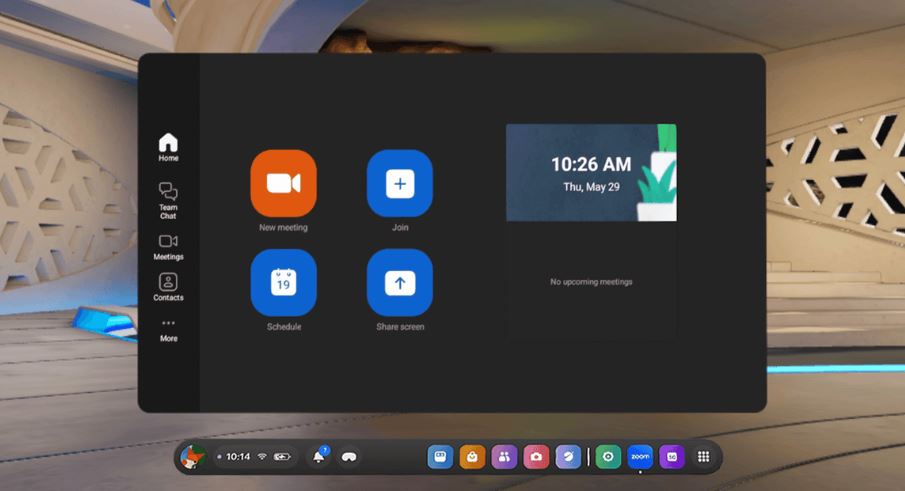
Zoom Meetings app on Meta Quest
Meta’s website highlights that the Zoom Meetings app on Meta Quest devices is compatible with any Zoom license, including free accounts, making the service accessible to a broad range of users. The app works seamlessly across multiple VR headsets, including Meta Quest 2, Meta Quest 3, Meta Quest Pro, and Meta Quest 3S. The interface of this VR app closely resembles what users see on desktop or mobile versions, but with some differences. For example, the navigation bar that contains options like Home, Team Chat, Meetings, and Contacts appears on the left side of the screen, giving users easy access to core features while in VR.
This development signals a significant step into the future of work and collaboration in virtual spaces. It aligns with Zoom’s broader efforts to expand beyond traditional video conferencing and tap into innovative technologies like virtual reality and artificial intelligence. The company has been investing heavily in AI-driven features aimed at making meetings more efficient and engaging.
AI Companion Feature
For example, Zoom CEO Eric Yuan has spoken openly about the potential of AI-generated digital doubles of users—virtual replicas that can attend meetings on their behalf. These avatars would act as stand-ins, handling routine interactions or providing summaries, freeing up users for more complex tasks.
Recently, Zoom announced upgrades to its AI Companion feature, including new tools for creating custom avatars for Zoom Clips. These avatars can represent users in videos, making the process of creating content faster and more scalable. Instead of recording and editing clips manually, AI can generate personalized avatars that speak or gesture, saving time and effort.
This push into AI and VR signifies Zoom’s ambition to stay ahead in an increasingly virtual world. It aims to create more immersive, engaging, and personalized meeting experiences. As meetings evolve into 3D environments with realistic avatars, the way people communicate will likely change, becoming more visual and expressive. These developments could lead to more natural interactions and stronger social bonds even when participants are physically apart.
Summary
In sum, Meta’s rollout of the standalone Zoom app for VR headsets marks a major step toward immersive workspaces. It offers users a richer, more engaging way to connect, share ideas, and collaborate in virtual environments. At the same time, Zoom’s focus on AI-powered avatars and enhancements shows a clear commitment to blending virtual reality with artificial intelligence to shape the future of digital communication.